


Because shipping can be one of the most complex tasks for e-commerce businesses, many sellers on Amazon use a service called Fulfillment by Amazon, or Amazon FBA for short. In this guide we explain what FBA is, how it works, and what it costs, and we introduce some suitable alternatives to Amazon's fulfillment service.
What exactly is Amazon FBA?
With Amazon FBA, the online giant doesn't just handle shipping itself. It also takes care of the entire process, including storage, picking, packing, shipping, and returns. One of the biggest advantages is that FBA products automatically qualify for Prime delivery. According to Amazon, this can boost sales by up to 26.5%, since sellers move automatically closer to the roughly 200 million Prime members worldwide, who rarely want to give up fast, free delivery.
What exactly is Amazon Marketplace?
Amazon Marketplace is Amazon's e-commerce platform that lets you, as a third-party seller, sell new or used products at a fixed price alongside Amazon's own offerings.
How does Amazon FBA work?
The only thing you still need to do as a business using Amazon's fulfillment service is send your goods to an Amazon logistics center, and in most cases the manufacturer of your product handles even that. Amazon does everything else. When a customer orders your items, Amazon picks them from its warehouse, packs them, ships them to the buyer, and answers any questions that arise. Even returns are handled by the marketplace operator.
What do you need for Amazon FBA?
To get started with Amazon's fulfillment service and benefit from the platform's reach, you have to meet a few requirements: you must be registered as a business and have a corresponding tax number from your tax authority. To import goods from abroad, you also need an EORI number.
How do I go about selling via Amazon FBA?
Want to sell your products via Amazon and use the e-commerce giant's fulfillment? With these 8 steps you'll lay the groundwork to become a successful seller on Amazon:
Assess supply and demand: can your products reach a customer base that makes business sense for you?
Determine the profitability of your products: weigh Amazon's selling fees against the potential revenue. Is it worth selling on Amazon at all?
Have your business details and tax number ready: if you decide to import goods from abroad, you'll also need an EORI number.
Register: use your business details and tax number to create a seller account on Amazon so you can sell your products.
Create a compelling product page: first impressions count. To convert as many people as possible into customers, you need a high-converting product page with appealing copy and images.
Stand out from the competition with marketing and advertising: huge numbers of businesses compete for shoppers on Amazon, so you can only win if you invest enough in advertising and marketing.
Continuously adjust your strategy: registering for FBA and listing your products is far from the end. Keep watching how your sales and margins develop and respond to trends with suitable measures.
Evaluate your selling activity: after a year at the latest, analyze how successful FBA has been. If the platform costs are too high in the long run, consider switching to Amazon FBM and organizing your fulfillment entirely in-house with a platform like Sendcloud.
How much does Amazon FBA cost?
There are two types of fees: ongoing fees and occasional fees.
You pay ongoing fees for:
Storage, based on volume
Shipping per unit, including picking, packing, customer service, and returns
Occasional fees can apply for:
Long-term storage (anything over a year, i.e. 365 days)
Returning unsold units
Processing fees for returns that are free for the customer
Unplanned services such as labeling goods after the fact
Put simply: storage plus shipping plus any extra services equals your Amazon FBA costs. Amazon provides a detailed list of all fees in its Seller Central portal. Here's an illustrative example:
Storage | Shipping | Possible extra services |
|---|---|---|
You pay storage fees monthly. Depending on product category, season, and size, they range from roughly €16.69 to €38.52. | You pay shipping per shipment. For example, if someone buys a €25 electronics product delivered in a standard 45 x 34 x 26 cm parcel weighing 3 kg, shipping comes to about €6.55. | You can book optional add-ons as needed, such as certain returns, disposal of unsold goods, special labeling, or protective packaging. |
Note: on top of this, there's the cost of shipping your goods to Amazon's logistics center, though most businesses leave this step to their manufacturers, so it usually stays within limits. A useful tool that calculates your profit alongside the platform's shipping and storage costs is the Amazon FBA revenue calculator.
Is Amazon FBA still profitable?
Recent analyses of the revenue of various e-commerce businesses selling via Amazon show that, despite rising fees, shipping your goods via Amazon FBA can still be a profitable business.
Can you make money with Amazon FBA?
The clear answer is yes, though not always easily and certainly not overnight. You have to weigh the individual pros and cons and keep an eye on the competition, which doesn't sleep and turns up in droves in most marketplace categories.
How much do you earn with Amazon FBA?
Your revenue depends heavily on the usual factors:
Which products do you sell?
What price do you charge for them?
How high is demand for them?
How many competitors offer comparable products?
How good are your product descriptions?
How high are the Amazon fees that apply?
All of this determines your profit as an online business on the platform. Surveys of businesses on Amazon suggest that one in two earns between €1,000 and €2,300 a month using Amazon FBA.
At what margin is Amazon FBA worth it?
The steady increase in FBA fees raises the question of whether selling via the fulfillment platform is still worth it. Calculating your individual profit margin can provide an answer. Ideally, your margin should be at least 30 percent for FBA to pay off. Selling products where your margin is only around 20 percent could still be worthwhile after some optimization (for example, adjusting your product copy or images), but products with lower margins are hardly suitable for selling from a purely economic point of view.
How do I calculate my products' profit margin?
A simple formula for calculating your profit margin is:
Profit / revenue x 100% = profit margin
Revenue is your total income, while profit refers to adjusted earnings (in our case, for example, after deducting the Amazon FBA fees).
Aren't there price wars in some niches on Amazon?
Especially if you sell products in the "electronics and photo" category, you'll quickly notice that this is one of the largest product ranges on Amazon. Strong competition can mean you have to adjust your prices to hold your own. But don't forget that customers are sometimes willing to pay more if your products are better than the competition's or you manage to present them particularly well.
How much startup capital should you have for Amazon FBA?
It's hard to give a general answer. If you already have a business with your own online store or are active on other marketplaces, startup capital for FBA doesn't play too big a role at first; you just need to make sure you can cover the additional orders coming through Amazon and Amazon's fees. Anyone who hasn't yet built a business and wants to start completely fresh on Amazon should bring roughly €2,000 to €3,000 in startup capital.

Who is Amazon FBA suitable for?
In principle the service is open to everyone, as there are no minimum quantities. But it will only pay off if the fee model based on storage and shipping costs works out for you. If you sell a bulky product that needs a lot of storage space but doesn't sell every day, the math might not add up. Take care with the following products for FBA:
Products with restrictions, such as medicines, tobacco, or alcohol
Categories requiring approval, such as food
Dangerous goods, such as firearms or their ammunition
Improper packaging that doesn't meet Amazon's requirements, for example because it exceeds the maximum dimensions, isn't sufficiently protected, or isn't properly sealed
If you want to sell products from these categories via Amazon, starting with FBA might not be an option.
How do I list products on Amazon?
To offer a product on Amazon, you first have to register with Amazon Seller Central. Then, under "Inventory" and "Add a product," you can check whether the product is already available on the Amazon marketplace. If not, you can add it via "Create a new product."
Is Amazon FBA reputable?
Despite its undeniably strong position in the international market, Amazon can't afford to alienate its partners with dubious services. The fee structure could be more transparent, but that doesn't make the service disreputable.
Aren't you heavily dependent on Amazon when using FBA?
Of course, as a business using Amazon FBA you're heavily dependent on the platform's requirements and fees. At the same time, though, you benefit from a huge potential customer base and don't have to handle your fulfillment process yourself.
Are low-cost overseas sellers a problem on Amazon?
Many e-commerce businesses fear competition from sellers who can often win the online battle thanks to much lower production costs. The good news with Amazon FBA is that Amazon itself has a strong interest in offering high-quality products on its platform. On top of that, registration requirements such as having a valid VAT ID make it harder for foreign sellers to access the platform, so you generally don't have to fear a price war with discount sellers.
Why use Amazon FBA? The pros and cons
Before deciding to use FBA, get a clearer picture of both the positives and negatives so you can weigh whether the fulfillment service is worth it. Most e-commerce businesses value the comprehensive services and sales advantages FBA offers, while criticism often comes on topics like marketing and cost.
Advantages | Disadvantages |
|---|---|
Comprehensive services | No placement of your own brand |
Reliable shipping | No contact with your own customer |
Sales-boosting Prime status | Extra costs from fulfillment errors that are hard to resolve |
Almost unlimited storage capacity | High costs, hidden fees, ongoing increases |
Professional returns handling | Growing competition, including Amazon itself as a seller |
Multilingual customer service | Tax questions due to possible storage abroad |
As a rule, before registering for Amazon FBA, check for yourself and your products whether the services on offer pay off and whether you can still make a profit on your marketplace sales after all fees.
What alternatives are there to Amazon FBA?
If you sell on Amazon's marketplace, you're in good company: close to 2 million businesses offer their products on the world's leading retail platform. So there's a lot to be said for Amazon. But that doesn't mean everyone has to use FBA to be successful. If strong competition on Amazon pushes your prices down while the fees on the world's biggest marketplace keep rising, it's time to look at alternatives to keep your e-commerce logistics optimally set up. And there are some.
1. Fulfilled by Merchant (FBM)
If you have access to your own goods, whether through a depot or your own warehouse, you can of course handle your orders yourself. On Amazon this is known as Fulfilled by Merchant (FBM).
Integrating a shipping tool
By integrating a shipping tool into your Amazon shop, you can easily process your orders yourself. Sendcloud connects directly to Amazon, imports and manages all orders, and automatically creates the right shipping labels. With a shipping platform you get direct access to a range of carriers, including your preferred shipping methods and pre-negotiated rates. You can even arrange pickup of your ready-to-ship parcels, so you don't have to organize transport or drop parcels off at a parcel shop.
Benefits for your Amazon shop:
Set up smart shipping rules and avoid errors: assign the right shipping method to each Amazon order automatically.
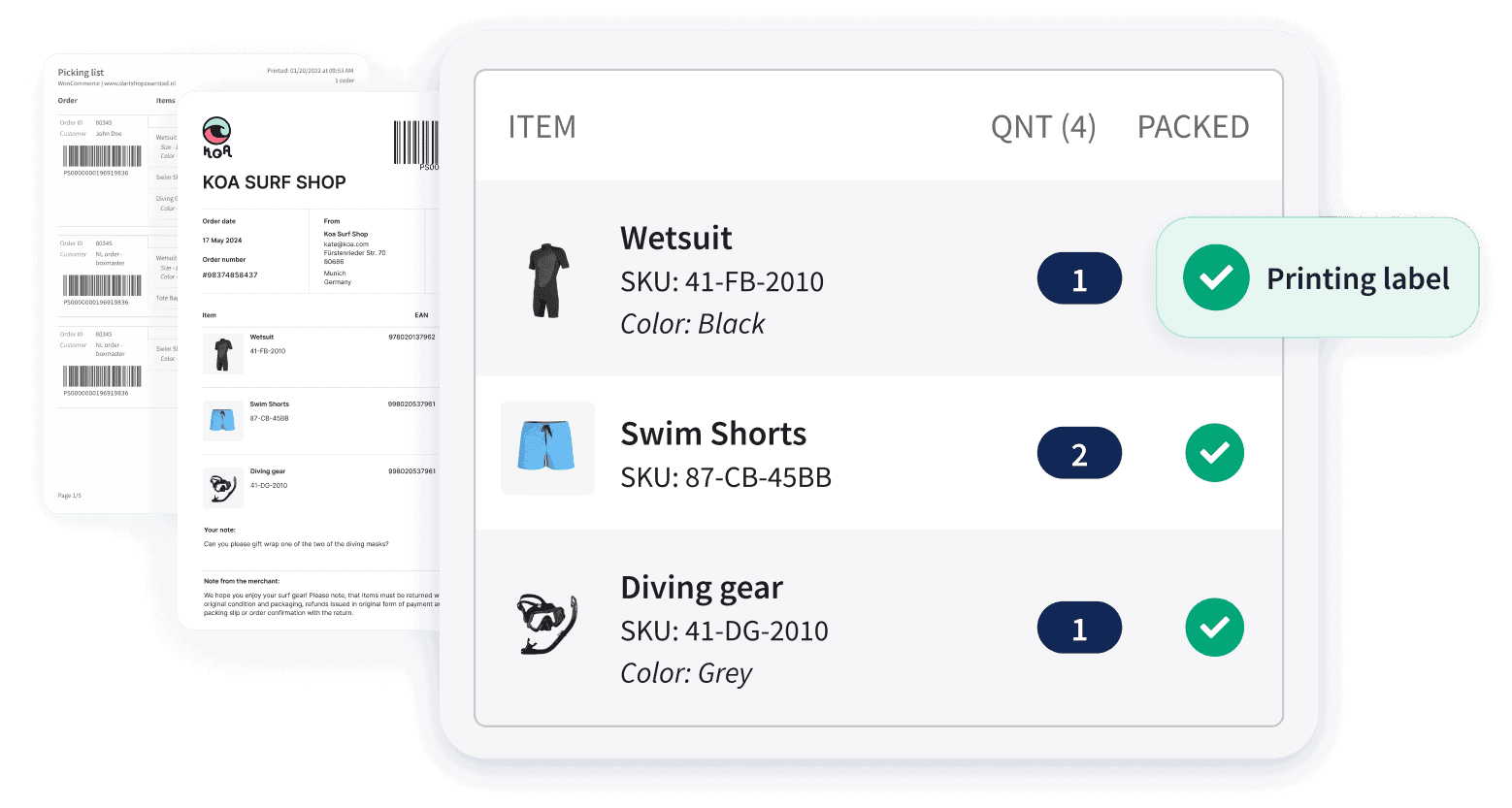
Pick quickly and easily: with a picking solution, process orders using digital packing slips and pick lists, and print the right label straight away via barcode-scanner integration.
Personalized tracking: your customers know standard shipping notifications all too well. Surprise them instead with personalized tracking emails for an unbeatable delivery experience.
Returns portal: create your own returns portal and set different return options per country.
Pre-negotiated shipping rates: benefit from the rates Sendcloud has already negotiated for you.
Analytics dashboard: get a data-driven overview of your orders and returns through a dashboard and use it to optimize your processes.
2. Seller Fulfilled Prime (SFP)
No way to process your orders yourself? Then you can also choose a third-party logistics provider (3PL) as an alternative to fulfillment by Amazon. These companies help you store your products, process orders, and handle picking, packing, and delivery. It's best to choose locally based 3PLs.
3. Dropshipping
Alternatively, you can use dropshipping, which lets you offer products you don't have to keep in stock yourself. Your customers order from you, but the orders are handled and shipped directly by the manufacturer or wholesaler. This option often has the drawback of longer delivery times, which can put customers off, so we recommend using a local supplier.
Isn't Amazon FBA the same as dropshipping?
Some elements of Amazon's fulfillment service closely resemble dropshipping, but FBA isn't dropshipping as such. With dropshipping, products are delivered directly from the manufacturer to the customer, whereas FBA is simply a service that covers the fulfillment process. It is, however, possible and even allowed to offer dropshipping products via Amazon, as long as the relevant guidelines are followed.
Amazon FBA: is the fulfillment service still worth it in future?
Shipping is and remains one of the most challenging steps for online retailers, whether in your own store or on a marketplace like Amazon. Given steadily rising FBA fees, you're probably wondering whether to keep relying on the service in future. On the one hand, Amazon's marketplace keeps growing year after year. On the other, that growth comes with steep fee increases that may rise further against a backdrop of inflation and higher fuel prices.
At a time when a personalized delivery experience matters more and more to customers, it's also worth asking whether an external fulfillment solution via Amazon FBA is still up to date, since customer expectations have changed a lot in recent years. We'd advise investing your time and resources in in-house fulfillment instead.
With the Sendcloud shipping platform and its handy Amazon integration, you can optimize your shipping process not just for Amazon FBM but for other e-commerce platforms and your own online store too.
Create your free Sendcloud account to get started right away:
Questions about your fulfillment setup? Get in touch with our team.

Author and researcher
Combining expertise in event marketing and communication design, Alexandra leads global event and partner marketing initiatives at Sendcloud for the e-commerce and logistics industry.


Subject matter expert
Greta Marini is a Product Manager at Sendcloud with a passion for automation and customer-centric product development. She contributes insights on shipping technology, workflow optimization, and the future of logistics innovation.
How much time can you save on shipping?

Share
Recommended For You
Shipping
Best label printers for shipping labels: a complete guide for e-commerce businesses
Choosing a shipping label printer? Learn when to use A4 vs A6, thermal vs laser, and how to set up a fast, scalable label printing workflow.

Fulfilment
Shipping label guide: What is a shipping label and how does it work?
Learn what a shipping label is, what information it contains and how shipping labels work in e-commerce.
Fulfilment
How to pack a parcel: Parcel packing tips for e-commerce merchants
Learn how to pack a parcel for e-commerce. Get step-by-step tips, avoid common mistakes, and optimise your shipping with smart packing practices.